
 EN



The axial flux motor stator lamination machine has become a cornerstone technology in modern industrial motor manufacturing. As axial flux motors gain traction across electric vehicles, renewable energy systems, and high-efficiency industrial drives, the precision and capability of the axial flux motor stator lamination machine directly determines product quality and production throughput. Understanding this technology is essential for any manufacturer aiming to stay competitive in the evolving motor production landscape.
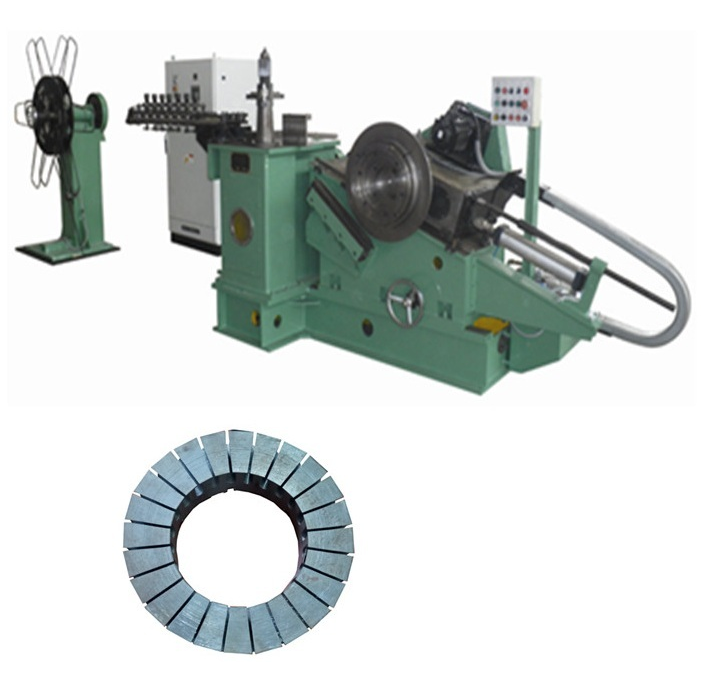
Unlike conventional radial flux motor production, manufacturing an axial flux motor stator demands a fundamentally different approach to lamination. The axial flux motor stator lamination machine is engineered to handle the unique disc-shaped stator geometry, delivering repeatable stamping accuracy on thin silicon steel laminations. Every axial flux motor stator lamination machine deployed on an industrial line must balance speed, dimensional tolerance, and material integrity to meet the demanding specifications of modern motor designs.
Core Technology of the Axial Flux Motor Stator Lamination Machine
Precision Stamping Mechanics
At the heart of every axial flux motor stator lamination machine is a high-precision stamping mechanism. The axial flux motor stator lamination machine uses servo-driven indexing to position silicon steel strip material with micron-level accuracy before each stamping stroke. This precision is non-negotiable because axial flux stator laminations must maintain tight tolerances on slot geometry, outer diameter, and stack height. A well-designed axial flux motor stator lamination machine integrates multi-servo control to synchronize the feeding, punching, and ejecting stages seamlessly. The result is a consistent lamination stack that meets the tight air-gap requirements typical of axial flux motor designs.
CNC Control and Servo Integration
Modern industrial axial flux motor stator lamination machine platforms rely heavily on CNC control architecture. The axial flux motor stator lamination machine uses programmable servo axes to adjust feed pitch, indexing angle, and stroke depth without mechanical retooling. This flexibility allows the axial flux motor stator lamination machine to accommodate multiple stator profiles on a single production line by simply loading a new CNC program. Servo integration on an axial flux motor stator lamination machine also enables real-time feedback on punch force and feed position, giving operators immediate visibility into process stability. Four-servo configurations have become particularly popular because they provide independent control over each major motion axis of the axial flux motor stator lamination machine.
Production Efficiency and Material Handling
High-Speed Strip Feeding Systems
An industrial axial flux motor stator lamination machine must process silicon steel strip at speeds that match mass production targets. The feeding system on an axial flux motor stator lamination machine typically includes a servo feeder, a straightener, and an uncoiler working in a synchronized loop. Proper strip tension management ensures that the axial flux motor stator lamination machine stamps each lamination without material distortion or edge burr. High-speed operation of an axial flux motor stator lamination machine also demands robust die maintenance schedules because worn punch edges directly degrade lamination quality. Manufacturers that invest in premium feeding systems for their axial flux motor stator lamination machine see measurable improvements in scrap rates and cycle time.
Stacking and Interlocking Lamination Output
The output stage of an axial flux motor stator lamination machine is where individual stampings become a functional stator core. Many axial flux motor stator lamination machine designs incorporate in-die stacking, where laminations are interlocked and bonded into a coherent stack without a secondary assembly operation. This capability embedded in the axial flux motor stator lamination machine reduces handling steps, minimizes stacking errors, and accelerates delivery of finished stator cores to the winding station. The in-die stacking feature of an axial flux motor stator lamination machine is particularly valuable for high-volume axial flux motor production, where even small improvements in throughput yield significant cost savings.
Application Scenarios and Selection Criteria
Industry-Specific Deployment
Selecting the right axial flux motor stator lamination machine depends on the specific production context. For electric vehicle motor manufacturers, an axial flux motor stator lamination machine must handle thin-gauge electrical steel at high stroke rates while maintaining sub-millimeter lamination accuracy. In wind energy applications, an axial flux motor stator lamination machine often processes larger-diameter laminations, requiring extended die sets and reinforced press frames. Industrial automation and robotics segments demand an axial flux motor stator lamination machine capable of frequent profile changeovers, making CNC flexibility a top selection priority. Matching the axial flux motor stator lamination machine specifications to the target application ensures the best return on capital investment.
Tooling and Die Design Considerations
The tooling system is inseparable from axial flux motor stator lamination machine performance. A precision compound die matched to the axial flux motor stator lamination machine press specifications determines slot accuracy, outer profile consistency, and lamination flatness. Die materials, coating treatment, and clearance settings must all be calibrated for the axial flux motor stator lamination machine and the specific silicon steel grade being processed. Regular die inspection and proactive maintenance of the axial flux motor stator lamination machine tooling system extend production uptime and protect lamination quality. Manufacturers should treat tooling investment as a direct extension of the axial flux motor stator lamination machine itself rather than a secondary concern.
FAQ
What materials can an axial flux motor stator lamination machine process?
An axial flux motor stator lamination machine is typically designed to process non-oriented silicon steel strip in thicknesses ranging from 0.2 mm to 0.5 mm. Some advanced axial flux motor stator lamination machine platforms can also handle amorphous metal or thin cobalt-iron alloys for specialized high-frequency motor applications. Material selection should always be confirmed with the axial flux motor stator lamination machine supplier before committing to a production setup.
How does servo control improve axial flux motor stator lamination machine output?
Servo control on an axial flux motor stator lamination machine allows programmable adjustment of feed pitch, indexing speed, and stamping force in real time. This reduces setup time between profile changes, improves repeatability across long production runs, and enables the axial flux motor stator lamination machine to self-correct for minor strip variations. The overall effect is higher yield, lower scrap, and greater process confidence for production teams managing the axial flux motor stator lamination machine.
What maintenance practices extend the life of an axial flux motor stator lamination machine?
Routine die inspection, lubrication system servicing, and servo calibration are the three pillars of axial flux motor stator lamination machine maintenance. Operators should monitor punch wear indicators built into modern axial flux motor stator lamination machine platforms and schedule die regrinding before quality degradation occurs. Keeping the axial flux motor stator lamination machine control software updated and conducting periodic mechanical alignment checks ensures long-term production reliability.